
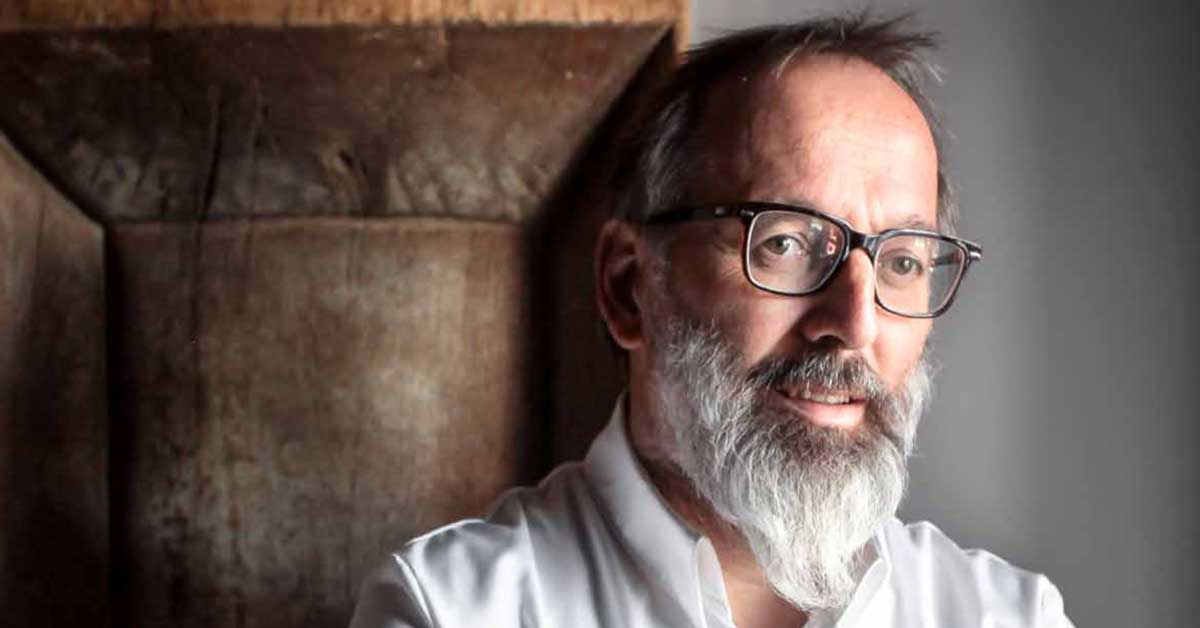
Professional intonation, questions written on a sheet of paper so as not to be betrayed by emotion; a mixed feeling of reverence, admiration and excitement. It's not every day that you get 'face to face' with Italy's greatest pastry chef! Iginio Massari, Golden Lion for Lifetime Achievementchairman of honour of the Coupe du Monde de Pastisseriè (the first foreign jury president on French soil by the way). Since 2011 his patisserie from Brescia is the best in Italy at Gambero Rosso guide and has won over 300 prizes, competitions and awards national e international.
Maestro, you opened Pasticceria Veneto in 1971 at the wish of your wife; where did the desire to open a 'boutique' in Milan come from? And why now?
"It was a desire I had for a long time, but I couldn't find the right place. Then there was an opportunity, and I took it. I opened in Piazzale Diaz and a stone's throw from Piazza Duomo. It was what I was looking for. Milan is a commercial balcony on the world, the drive you have in this city is totally different from that of many other places, especially provincial ones'.

Milan, the fashion capital. Is there also a fashion that influences your creations?
"The world changes, not only in fashion; the world changes in everything. Even in food, for the simple reason that communication interchanges are so high that cultures are ruthlessly intertwined; I say ruthlessly because real identities are almost always lost, unfortunately. And what's more, communication is not done by specialists, but by the whole world: nowadays everyone believes they have the truth in their pocket, and this almost never happens. Truths have to be dug out, searched for, looked at... and seen. Instead, today there is a lot of talk without a culture of history, without knowing the past, and this is a real shame'.
She has often stated that if the recipes used are perfect, you will have a good product.
"Yes, obviously if you respect the rules, because if the rules are written down but you don't read them, you will hardly get the answer, which is a very good result. You know, when you talk about a 'technological' product, it is based on numbers, and of those numbers you don't just have to respect the first two, you have to respect them all the way to the end."
This is the mathematical part of the art of pastry making, but what is it that makes the difference?
"I think the world runs on a mathematical basis; probably many people don't know this, but it is my opinion".
Master, I say three words to you and you respond instinctively with what comes to mind.
- Creativity.
"It does not exist. In any work, it does not exist. If we look at creativity in the fullest sense of the word and we are believers, we realise that the creator was only a great deity, whom someone called God. We discover, we mix, we make things.... Some call it fantasy, but in my opinion only those who do not have the ability have fantasy. You see the contradictions as they are: it is said that Italians are a people of imaginative people, but if one is in trouble, one can only get out of it by knowledge (mastering the methods and rules), not by imagination'. - Sacrifice.
"No way. If you do something you like, it's like making love to a beautiful woman: then you can't say you sacrificed yourself for a quarter of an hour or a whole day. Normally you do what you do because you like it. And if you like it, there is no sacrifice. There is rather pleasure, there is gratification, some call it happiness, I don't, but what is certain is that it brings you complete serenity. For me, work is fun and it gratifies me.
For a saint, doing Brescia Milano on the asphalt with bare knees and arriving at the destination only with his bones is not a sacrifice, because it is through pain that he sanctifies himself; for him it is self-realisation. - Curiosity.
"It is the spirit of innovation. He who has no curiosity remains old even if he is only 20 years old'.
Why do you call yourself a craftsman and not an artist?
"Because the artist does something that is no longer repeatable, whereas the craftsman has to make repeatable things that are within everyone's reach and his ability is to make extraordinary things that enchant people. The artist must be able to predict what our future will be, and this is so complex that it always becomes difficult for me to call someone an artist.
And what is the enchanting magic that her sweets infuse?
"The magic is first of all to understand and know the raw materials and then to try to understand people, which is already a much more complex thing. I try not to do what I like, but what other people like'.

The dessert that most represents you?
"There isn't one, because I always put my whole self into each one equally. I always put everything I have learnt over the years on the field and at my disposal".
Does pastry, and especially Italian pastry, have anything to teach today?
"We all have something to teach and we all have something to learn. Only the French say that they only teach!".
How does one become Iginio Massari?
'You just have to have love for what you do, a lot of curiosity and never declare yourself defeated'.
How important are the people we meet in the course of our lives for what we then choose to do?
"I think that every person we meet affects the way we act and do, maybe a little, but it always happens. Even those people who seem negative in the end give us something and those who don't pay attention and are not curious waste a lot of time talking about the dark when they may already have lanterns in the house'.
Is there anyone who played a really fundamental role in your choice to be a pastry chef?
"Definitely my mother. She was a cook, she made sweets and especially ice cream. Cooking was part of her world. My father on the other hand was a civil servant, two completely different worlds: one started early in the morning and finished late at night, the other started late in the morning and finished early in the afternoon'.
What is your philosophy of life?
"I've probably always got it wrong, especially towards my children, because as I told you before, for me working is not a sacrifice but fun, so I, like my mother, start early and finish late, and they, my children, see me working 18 hours non-stop. But I don't complain about what I do, because I do it with joy, I do it because I want to. For me, holidays are a sacrifice, standing there doing nothing, I feel like I'm wasting my time. To some people I may sound like a madman, and they may even be right. But it is my way of life. I think I was born to be a pastry chef because in doing so I am able to use both intellect and manual dexterity; they are two things that go hand in hand, even if at the beginning of the 18th century ideas began to be rewarded, but then, as time went on, manual dexterity was given more importance and today I have not understood whether manual dexterity is more important or proposing innovative things.
Maestro, is it true that you write poetry?
"It is my truest damnation!"


 English
 Italian