
Wine: a history so ancient that it has descended into legend.
Montagna is a tiny village in the province of Bolzano and when you get there, it smells like a fairy tale: from there, you overlook the green mountains of South Tyrol and, while the wind caresses your face, you can see rows and rows of neat vines everywhere, below and around you. All that green lightens the mind and smells of handed-down tradition. When you then enter Franz Haaslegend becomes history and grapes are magically transformed into bottles.
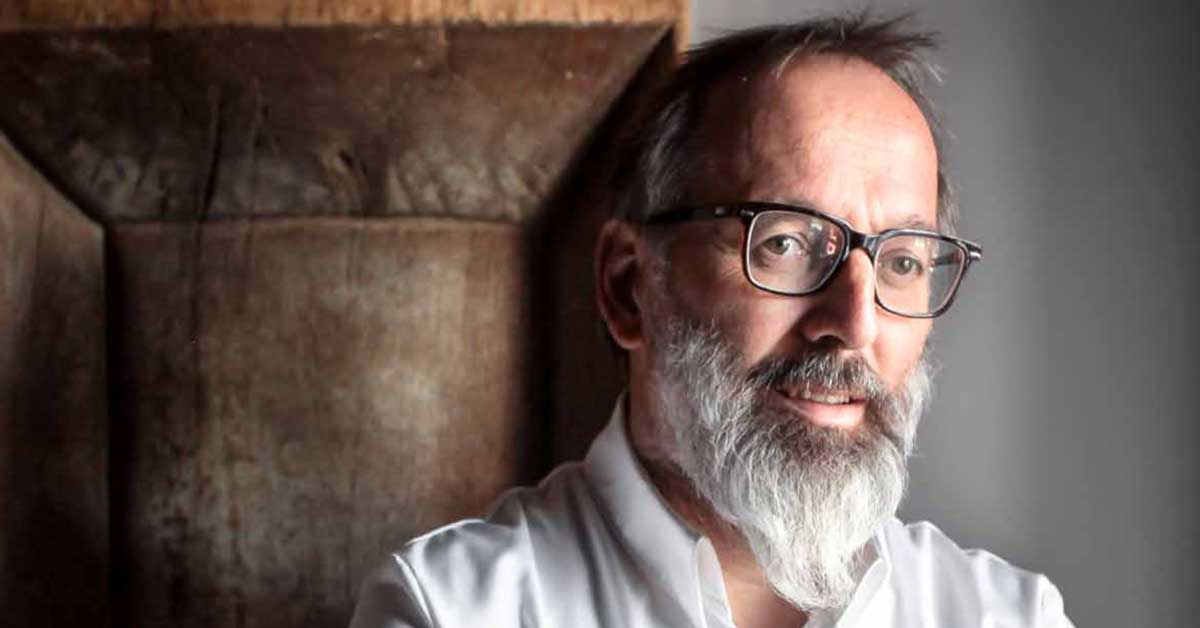
Franz Haas is not just a winery, Franz Haas is a man, a family that has been making wine for seven generations, and has put a philosophy of life into wine.
For wines are not all the same, wines are the children of the fathers who created them and Franz Haas VII is an attentive and caring father. He seems shy, taciturn and reserved, but when you ask him to explain what is behind a straw, amber or black goblet, he will stop to tell you how that fragrance of rose and lichis explodes in the Gewürtztraminerwhat it is that gives it the pleasant aniseed and cinnamon aftertaste...
You'd listen to him for hours as he tells you what it is that makes grapes such a distinctive and distinctive table nectar. And yes, for taste, I am partial to the Gewürtzbut he, on the other hand, loves pinot noir, because "every good wine is my favourite, but pinot noir has an incredible range of interpretations".
And so, as he recounts, you dive into the play of colours of these grapes, from light to deep ruby red, depending on the vintage; marasca cherries and raspberries transport you on a journey that takes you to the undergrowth, passing through marzipan and plum jam. Pinot conquers you yes, and you discover that magic, as I like to call it, is made of altitudes.
Why Franz Haas is a man of tradition, certainly, but he also has in his soul the spirit of innovation and experimentation, the spirit, even more, of a man in love with wine and who has discovered that high altitudes give grapes unique, sublime characteristics. For nothing does he weigh the effort of the 'struggle' to improve the laws in force that regulate altitudes for planting: the Pònklerwith thirteen years of experimentation behind it, is the pinot fruit of the latest challenge, grapes growing at an altitude of over 900 metres. Which will not be the last of challenges, no, Haas VII He still has a long way to go, because for him wine is synonymous with life.
"Until my father's or grandfather's generation, the winemaking tradition was handed down more out of corporate obligation. Because that's how it used to be. My father had a not very good youth: the usual family history, the usual generational tears! My grandfather was a human character, a man who did everything to ensure the survival of the country. His brother, on the other hand, was an arrogant bully; in his time he grabbed my father by the throat, put him up against the wall and tried to discourage him from his desire to make wine.”
“So when I was 17, my father, supported by his older sister, brought a lawsuit against my uncle to safeguard the rights to my father's inheritance. It was perhaps more out of anger that he decided to 'get into wine' and built this wine cellar, making everyone believe it was a stable because he was afraid of his uncle. But a close friend of his, a wine broker, told him one day that he supported him and would help him sell the wine he produced. This is how my father started, trusting this gentleman, and it went well!”
“As a child I always worked in the cellar, I liked it, but then came the generational conflict: I just couldn't get along with Dad! He was the man of numbers, calculations, predictions, the mathematician, not me, I was more psychic, I was the human... all lies... because then I became worse than him! Unbelievable!”
“Anyway, I left home. I wanted to study. I wanted to become a criminologist. The school was in France, but you had to have a degree to be admitted. So I enrolled in economics and commerce, when one day news suddenly changed my life: Dad still had six months to live! I was not head of the family and if I stayed abroad to study I ran the risk of becoming a deserter. So I returned to Italy, did my military service and then began studying oenology. In the meantime my father met a doctor, let's call him esoteric... well my father died four years ago! Six months after starting the prescribed treatment, not a trace of the evil... But by then I had made a forced change of course. Dad was well and we didn't get along again... I opened an Italy-Germany mediation company until in 1986 Dad finally decided to let me do it.”
“This is when I really fell in love with wine. Today my hobby is my job and my job is my hobby and I can consider myself a privileged man. I think I have been very lucky in my life, I have met the right people, I have found a wife who knows how to do everything that I don't know how to do: she is the great character of human relationships, I am not capable of that. Luisa, my wife, always blames my zodiac sign. I don't believe it but she has always had problems with all the Scorpios she has met and maybe she is right. You know, I was a coach and out of 12 players on the team, 7 were scorpions: we couldn't win. They were great, but we weren't winning! My luck is that when there is something wrong, the first question I ask myself is where is it that I am wrong. I don't feel like blaming others. That time I said to myself: OK I'll go to the psychologist! I found a psychoanalyst, who at the third session asked me a question ... well that question changed my life. From that day on we haven't lost a game for five years ...".
We will never know what that question was, what we do know is that Franz Haas won, and not only the matches of the team he coached. He likes challenges. "Maybe that's what keeps me young and energetic' he laughs, while already thinking about that perfect wine he demands of himself and has not yet managed to produce: 'I have a dream to realise: that wine I would like to make... Every year there is a batch that comes very close, but it is never the same vineyard or the same type of processing... it changes every time. There are so many parameters I can't put together yet, I have to figure out how to match them in the right way. But I'm hopeful; my doctor told me I'll live to be well over 100 years old, so I still have some testing to do!".
Here is the numbers man, mathematician just like his father! But the 'psychic and human' part, as he called it, is what makes the difference. Because there is not only mathematics behind the resolute personality of the Pinot Grigionor behind the seduction of the spicy sweet caress of the Pink Muscator the velvety, deep and intense flattery of the Lagrain... To make superb wines (because that is what Haas wants) you need science and calculation, of course, but love, passion and determination, character, give the picture the brush strokes that give it light and depth. It takes art, the kind you have in your blood, a loving creative genius that even the clothes on the bottles Franz Haas and the names of the wines convey.
"The labels are an engagement gift from Luisa - tells Franz Haas -. Richard Schweizer was an artist, a disciple of Picasso, Chagal e Miró; one evening at dinner my wife asked him to draw some draft labels. He took out his colours and started painting on the restaurant menu paper, which was glossy black. In half an hour he did about fifty of them! When I saw them, I did not have the courage to use them; I lived in fear that someone might buy a bottle just for the pretty label, my pride would not bear it! But Luisa cared a lot and so I dedicated the Mannathe first label with a work by Schweizer and Luisa's surname. It is a successful wine after 7 years of trials. I wanted a product that could go with all courses of a dinner party, a versatile wine.”

“Then there is the Sofywhich is named after my daughter, Sofia. The label is a design she made and which I liked very much, and the wine is dedicated to her because one day she asked me to try to make a product for young people, an 'easy-drinking' wine, that is, with a less demanding profile.”
“After that came the Lepusa name created for a purely commercial reason. We could not increase sales of pinot blanc. Thinking and rethinking, we realised that all pinot blancs from theSouth Tyrol had a name, so ours must also have one. What name shall we give it? Sofia asked me how to say rabbit in Latin. Because Haas in the family crest has a rabbit playing the trumpet, the surname comes from Scandinavian where my family has ancient origins and it means rabbit, hare. Lepus! We call it Lepus and sales increased by 50% the first year.”
“That makes me a little angry! Wine is always that, with or without a name! It is always just a question of marketing. It is demeaning!”
“However, the other names then are simply the names of the wines and the labels are always those designed by Schweizer".
We leave it at that, Franz Haas, with his anger at those who buy a wine just for a name or a label. Looking gruff is part of his 'character', after all. We sip a pinot noir, the one with spicy notes of pepper and leather....
I was left with a doubt: but what will this 'perfect' wine that you dream of one day producing be like? But yes, all the better, we will know when we taste it!




 English
 Italian