


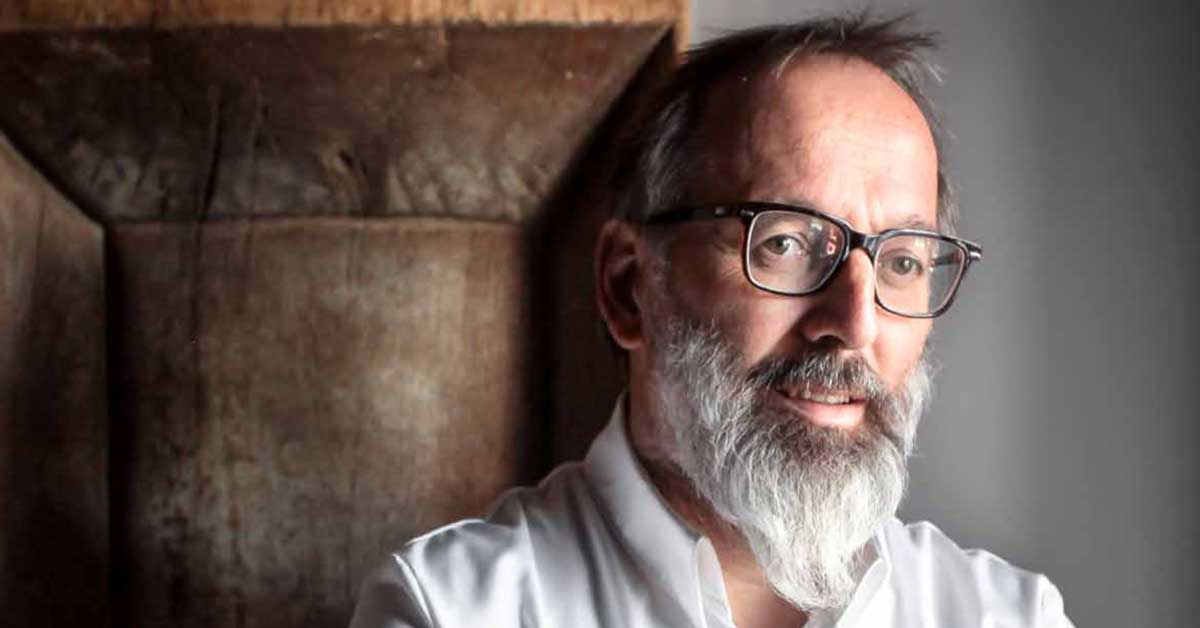
When he put on his first white shirt he declared that he was born for the second time.
It was the year 2001 and that shirt, which today still Filippo La Mantia wearing, it is the chef's smock.
But a rebirth is not complete and true without a baptism, and the initiation, in this case, has the name of "Host and cook': that innkeeper who in his childhood memories greeted customers by reciting the menu, and that cook who offered seasonal produce.
Yes, because in rebirth, roots are not forgotten; after all, we belong to the true birthplace and remain enveloped in the womb of the colours, sounds and flavours in which we grew up, wherever we go. When, then, that womb is Sicily, with its variegated and strong scents, penetrated by spices and aromatic herbs, the bright and incisive colours never abandon its children.
This is what happened to La Mantia, who always carries his land in his heart and, having abandoned his job as a photojournalist, that Sicily is reflected in the dishes he cooks every day, in his Milanese restaurant, elegant and designer, which he himself has called "a projection of Pantelleria". A small 'island' where you wake up in the morning with the scent of cannoli, the aperitif has the happy and carefree crunchiness of freshly baked panelle and the table is nourished with all the hues, fragrances and tones of flavour that Palermo's Vucciria market has imprinted in your memory since the days when you went there with your grandfather.
Filippo La Mantia He is a cook who offers seasonal products from the Sicilian land, but in his dishes, although anchored in tradition, reinterpretations and evolutions do not fail to peep out, giving each dish that peculiarity that makes it recognisable as his and only his.
No garlic and onion for example, masterfully replaced by citrus pestos. And if you think this is technique or strategy, he replies: "I don't like them and therefore don't use them, that's all". Because let's remember, he is not a chef, he the name of Host and cook has it embroidered on his tunic, and proudly states: "Chefs have studied, they constantly update, they know all the techniques. They have made food an element of research, I am more raw, more spontaneous. In my type of cooking there is nothing constructed, my dishes are made almost extemporaneously".

Extemporaneity that goes hand in hand with immediacy and intuition, the same ones that were necessary and so natural to him behind the camera and that today, together with aesthetics, are the magic wand that gives dishes their uniqueness. Uniqueness, on the other hand, comes from memories.
"Fresh fennel, oregano, the smell of fried aubergine. In summer, the women of the family all prepared caponata together: some toasted the pine nuts, some made the tomato sauce, some washed the basil. It was a sort of picture made by several hands and it was a dish that lasted all week, because vinegar and sugar are a natural preservative. This, the summer kitchen, is the kitchen of my memories and when I think of a recipe it is these memories that stimulate me. My dishes are not necessarily a faithful reproduction of traditional recipes, but Sicily is there, because I have it in me.".
And hearing him talk about his recipes conjures up in the listener precisely the image of the joy of a family Sunday; it is with that festivity that he prepares food for his guests because, he says, "cooking is beautiful, it is a nutrition project, like when a woman feeds her baby. The most fascinating thing about this job is to communicate an idea through food".
The most difficult? The answer of Filippo La Mantia says it all: 'Making people eat! Because today he has very high expectations of cooks, he always demands the unbelievable!".
The media phenomenon here had a hand in it: "Everyone nowadays - continues the Sicilian host - they feel like sommeliers, gourmets, grand gourmets. They enter restaurants believing themselves to be who-knows-who, and this has unfortunately changed the perception of cheerfulness around a dish".
Here is the family cheerfulness that the culinary project of La Mantia wants to bring back to the table. For now, in the words of all the people who numerous sit at his table every day, the project works.
And if he calmly says "if one day people no longer want and need to visit me I will follow one of my many passions (I play music, I paint, I love riding motorbikes and travelling...)"we hope that Filippo La Mantiawith its cuisine, continues to make a little bit of its wonderful and cheerful Sicily beat within many hearts.
Aubergine caponata, rice arancina, pizza with mashed potatoes, warm seafood salad, potato gateau. Thus greets you, on the front page, the menu of Filippo La Mantia. His "caponata of memories' to welcome before and over every dish: strictly fried aubergines and that same scent of tomato, basil and pine nuts that the women of his family used to fill the house with on Sundays.
The seafood salad is greeted on the bottom of the plate, a signature note, by a brush of squid ink, which welcomes the octopus, prawns and squid. As tradition dictates, the fresh parsley decorates and flavours, and it is its aroma that envelops you first, then greets you with its hint of sweetness and a small, slightly spicy garnish.
But you can't really taste Sicily without the arancina. The only protagonist at the centre of the plate, no frills, it doesn't need any. It is perfectly spherical, proud and dressed in a dry, crispy breadcrumbs; and when you open it, the soft filling awakens the enthusiastic, childlike appetite we all have inside. Gran ragù misto, as the menu mentions, doesn't quite convey the idea: you have to cut it, the arancina, and watch the meat with its tomato sauce slowly slide to the bottom of the plate, tickling your eyes and palate, while the rice remains embraced by the crunchiness of the sphere. The peas and the cheese do the rest, and what explodes in your mouth at the first taste I think is nothing but the pure essence of cheerfulness around a dish that La Mantia wants to bring to the table every day. You can't help but smile when eating an arancina like this!

Continuing the journey through the menu, you cannot miss the spaghetti alla Norma, spaghetti, not macaroni, because the cook told us: you don't need to reproduce traditional recipes perfectly when you have a land inside you. Among the first courses, the irreplaceable cous cous, which the cook proposes with lamb and vegetables, is flanked by bucatini with sardines, fennel and toasted breadcrumbs. But it is the mixed pasta with potatoes that seduces us, flavoured by the bottom of the mantis shrimp and an overpowering smoked provola cheese. Creamy and spicy, in spite of those who believe that garlic and onion are fundamental and irreplaceable in dishes.
Of main courses, between fish and meat, the choice is vast; but the cook's intuition and aesthetics transcend in the oxtail timbale. The meat is enclosed in a crunchy pastry casket; you have to open it up and enjoy it with the soft flavours that await it at the bottom of the plate, cabbage in the first row. The flavours are strong, as tradition dictates, but the marsala gives velvety texture and the pulp of the annurche apples defats and sweetens the preponderance of that fifth quarter that not everyone is used to.
The feast of flavours ends majestically with the desserts, which flood the table with Sicilian culture and tradition par excellence: from the classic cannolo to the zibibbo mousse, from pistachio bavaroise to almond granita. The meringue with peppercorn pears competes with mascarpone cream with honey and citrus gel; but there is also the "Caldofreddo di San Vito Lo Capo"with hazelnut ice cream and yes, her, the cassata, the Palermo one, with ricotta and marzipan.
That's right, the Filippo La Mantia is just a little Pantelleria!





 English
 Italian