

Kindness and hospitality. This was the first enveloping scent that greeted me when I entered D'O and shook the hand of Davide Oldani. Design furniture that embraces lightness; large windows that let you breathe in the square, overlooking that tree, the elm, the seed of the life of the village, San Pietro all'Olmo, in fact, but also of the profound philosophy of a man who, once out of there, got under my skin.
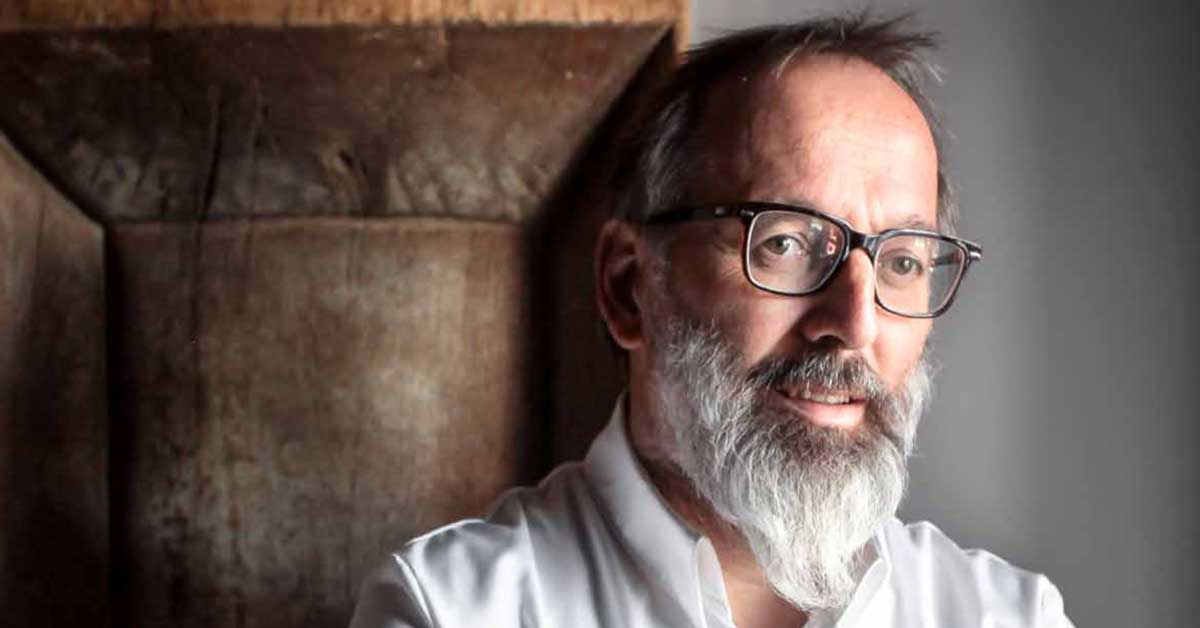
Davide Oldani is like his restaurant: elegant, refined, gentlemanly. His defining of himself as 'cool pop' soon reveals itself to be a natural sociability, and you realise that that inclusiveness he narrates with his dishes, that desire to give quality togetherness, he has sewn it on.
Quality: he loves it, in everything. In food, in places, in objects, in details, in people. 'I have allowed myself the luxury of choice,' he says, 'and I only ever choose quality.

And there is sincerity, pop that too, sister and mother of quality. The prerogative of the open kitchen, so sincere that it does not even need glass. Transparency is absolute, welcoming respect, which Oldani teaches and demands. A respect that starts precisely
from there, from the kitchen, where the morning and evening handshake is a must, and then spreads everywhere, in a single inclusive embrace, of places and people, of welcome.
'Room and kitchen do two different jobs,' he explains, 'but they are one. It is like in life. Men and women, different cultures and countries, yes, but a man grows if he has a real sense of diversity, if he listens and compares and does not try to impose his own idea'. You must enter D'O and listen, 'feel' everything: the scents, the colours, the flavours, the people. And listen to him, Davide Oldani. This is the only way to truly understand what pop cuisine is, that art of fairness and taste, the chef's icon, the art of caramelising dreams, as he called it in one of his books.
Caramelized is its onion, and it is not a fad. It is the mirror of a mission, that of making food culture, with dishes conceived ethically, using territory and seasonality. It is perfection given by the balance of contrasts, that balance now known as the 'Oldan method'. "Cooking must be democratic," he explains. Expo has taught that food must be for everyone. But balance is also democratic. The palate and the tongue are the same in each of us, and indulging the palate means putting hot, cold, soft, crunchy, salty, sweet, with balance. If a dish touches all points of the palate and tongue with balance, it is necessarily good. Balance, in short, is a 'reason why', the only democratic method of judgement'.
A balance that requires order, technique, rigour: 'If you want to be a professional, in any field, rigour is essential. Just wanting to be an artist is not enough'.
Him, Davide Oldanirigour is kind of painted on his face. In the kitchen, rigour is certainly a dictatus for him, but then he is sitting there in that armchair. Around us, the black and white tables (designed by Oldani) play harmony with the square cushions, also in black and white. Suddenly but neatly, they are displaced by soft acid green companions. They too, however, unexpectedly green, embrace their puffs of the same colour, while the pictures, small photos on a wide white background, symmetrical to fill an entire wall, are illuminated by sconces and abajour modernly slender and essential.

The balance of contrasts, you notice at some point. And in the meantime he, in that armchair, gets a bit lost in the chatter. The rigour turns into a smile and that's when you look into his eyes and really listen to him, more, because you realise he is talking about himself. "If the caramelised onion is burnt and the ice cream is not on top, when I serve it to you you have a different feeling than when it is not burnt and there is cold ice cream on top contrasting with the heat. It really is a democratic method of judgement. Democratic and pop! Pop is not a label for music and art. Perhaps cooking is more pop than any other art form. The sighted cannot see a painting, or a sculpture, the deaf cannot hear music. In contrast, cooking penetrates everyone and must have a balance to be appreciated. In life, too, we all seek a balance. Some go to church, some do yoga, some take long meditative walks... because balance is important, if you are a balanced person you win!
There is always a part of us, the instinct, that urges us to evade, and that is fine, it should be done, but evasion should not be a constant. A perfect balance requires commitment, effort, reasoning. I am sometimes impulsive and that balance I have in the kitchen I would like to achieve in life too, but it is not easy!
Life... Every trade comes down to you. Listening to Oldani you realise that cooking, precisely because it penetrates everyone, dresses you more than ever. "I do a job that keeps my feet firmly planted on the ground. Cooking, food, teaches you that the speed of man is not to do a hundred metres in eight seconds, and it is not the speed of smartphones. Every day, at lunch and dinner, we all have to take our time. Even if we eat a sandwich, because eating is a necessity of life, we have to stop for five minutes. Eating is not a like or an emoticon; cooking is not just visual, nor is it just olfactory. Someone said that cooks pass and men don't. I always repeat that. If cooking has reached the level of notoriety it has today, it is because we have realised that food is our true speed, that it is important. Why not leverage this? Food puts the human factor first. This is pop cuisine: cooking is sociability, collectivity, sharing, being together. Cooking unites'.

Chefs and cooking go bye-bye. For Oldani, recipes are fun, which is why no dish is forbidden to be revisited. Because tradition is maintained with taste; because, above all, it is the products that make the difference. Those products which, the cuisine of fairness and taste teaches, must be strictly seasonal. Not only in Oldani's home, but in the homes of us all. "The more seasonal we are, the more healthy and quality we eat. And then, when we go shopping, we think before we buy and weigh before we cook. If you have no waste in your shopping, you have no leftovers in your cooking!"
The importance of the seasons is so anchored in Oldani's philosophy that if you ask him what colour his kitchen is, the chef replies: 'We are in winter, so it is brown, more or less intense, certainly the tones are soft'. And again the pop chef gets wrapped up in his comfortable armchair: 'A personal colour in my life at the moment is light grey. In the beginning, fifteen years ago, it was much stronger colours, the strong yellow behind the Arrigoni wall in my old trattoria'.
Grey or yellow are the colours, Davide Oldani he has not stopped caramelising dreams, those of his guests, but also his own. "Dreams are free, they are what allows you to lighten up this life that is sometimes a bit heavy. I have a lot of them. The fact that I always have a dream ready in the drawer allows me to cope well with everyday life. The dream is my medicine. It makes me realise that I am connected to everyone and no one. If I want, I can change my life tomorrow, so I do well, the best I can, today. Which doesn't mean doing a bit and a bit though. I was a footballer, I was in the C1 league; I was sixteen and it seemed like football was my future. Then, Sliding Doors. Broken leg! And from morning to night I had to take up my second dream, cooking. That's why you always have to have a dream ready to pull out!".
Kierkegard said that our whole life is encapsulated in three words: choice, possibility and time. Davide Oldani He understood this well; he, that 'D'O is rhythm to be felt and kept, within a time to be respected, always, whether it be a season, a cooking interval or a hall time'. Possibility and choice open the door to freedom, and for Oldani, freedom is pop.
Sliding Doors. Life is none and a hundred thousand, yet one, the present. And it is the same for the kitchen. If this is one of the infinite possible worlds, living it to the full and giving a bit of yourself to others is the only possible freedom. This is what it means to be a 'cool pop' cook: humility linked to tradition and brought to the table for all; taste, elegance and respect for others.


 English
 Italian