

A suitcase always ready, dreams in your pocket and... a good plate of tortellini.
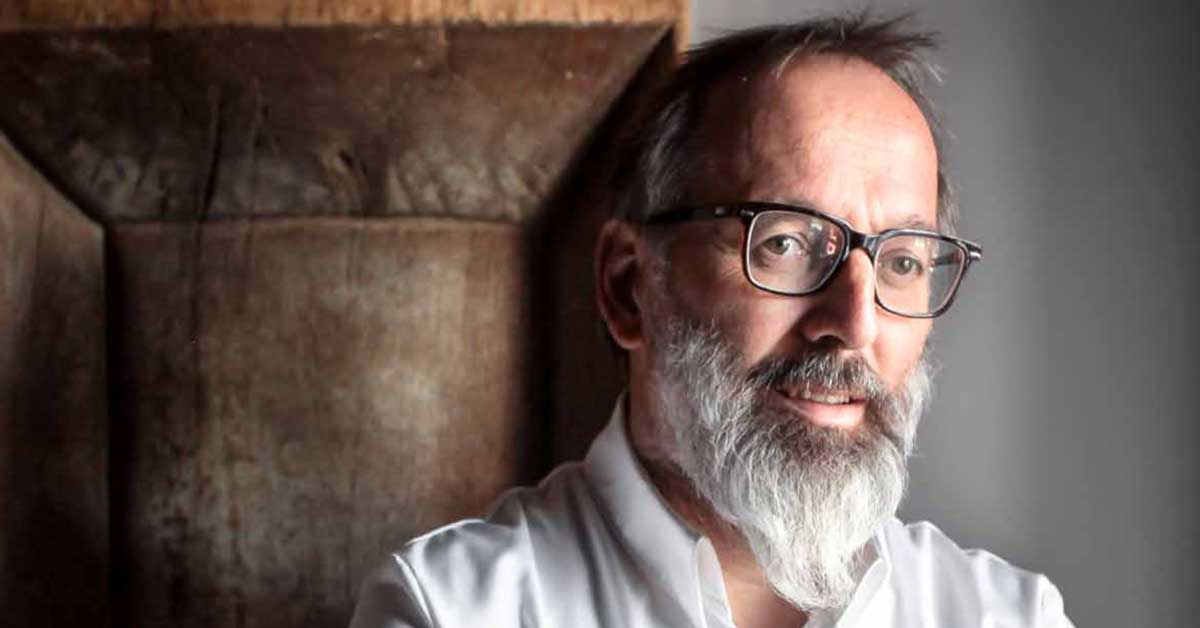
He needs no introduction. He is first and foremost a chef, who has dedicated but also sacrificed his life to this profession, so that he has become a great seven-Michelin-starred chef in his career. Then there is the public figurethe stern judge of Masterchef and the much-loved 'hunter' of the best Italian hotels, who amazes viewers with his passion for fashion, showing off with elegance and spontaneity combinations that are unlikely for many, but which instead give him a certain charm. This interview with Bruno Barbieri aims to tell the story of the character and what is behind it, to try to grasp what the ingredients of a successful career are.

We met Bruno Barbieri out of the kitchen and off the screens, on an ordinary day of the week, at home with a fever, impeccably improbable in his looks and with his distinct sense of humour. No filters, with him you don't need them. Sit comfortably in your armchair and enjoy this spontaneous and sincere chat, obviously with a lot of Bolognese cadence and expressions; eliminating or replacing them would distort the essence of the man and the chef Barbieri, who, let's face it, is perfect like this!

Bruno, how would you sum up your cooking philosophy?
Well, first of all, let's start with the assumption that I am extremely convinced that chefs are born, not made, in the sense that it is a job that you have to do because you love it and not because maybe you have decided to go to hotel school and, because it is fashionable today, then ok let's all become chefs! No, this is a job that you have to live it inside and my cooking tells exactly who I am in my life. I have never been an extremist chef. I consider myself a chef who does contemporary, modern cooking, but at the same time it always tells the story of my life: where I have lived, what I do, where I am from.
Ours is the most beautiful country in the world gastronomically speaking, the raw material that there is in Italy is nowhere else on the planet. Then people can tell me that mosses and lichens are also good, but I prefer truffles, two drops of balsamic vinegar, a few slivers of parmesan, a nice fassona tartare, and good morning and good evening! I think that in order to eat well it is essential not to forget your roots, to always remember where you started from, and all these things here. Then it's normal that you have to make everything more modern, everything more 'in the present day', because life habits have changed a lot and so we can't eat like we did fifty years ago.
The other thing I am convinced of is that this is a job you cannot do forever. Because it eats you up inside, it's tiring; it's a job that requires you to make sacrifices in life if you want to do it at certain levels. If you really want to live it you have to do it 24 hours a day, all the time. But then, of course, you reach a point... for example, I don't have the physical strength today that I had when I was 25 or 30, when I could stay awake for three days and nothing would change. I started this job in a really 'powerful' way, I went to work on cruise ships, away from home, far away. But I did it because I needed to gather experiences, moments, things, and then be able to put it all on a plate, because mind you, it's not easy.
Nowadays young people say they want to be chefs because maybe they watch television and see chefs like us who, in quotes, have arrived, but to get where we are, we really had to sacrifice a lot. You have to travel around, because life is made up of moments, of sensations, of situations, and a chef has to be hungry all the time, not just for food, but for experiences and situations; he has to travel and then return home and tell everything on the plate. This is what it means to do modern cooking.

So you are telling young chefs that they must have a lot of passion and travel a lot....
Of course, but yes I think it is. I have travelled around the world and discovered things that I would never have discovered if I had always stayed in Milan, Bologna or Italy. But the fact of being able to do all this and not forgetting one's roots is fundamental to doing a good job. Then in life you also have to have a bit of luck: meeting the right chefs, being in the right place at the right time. But in the end what counts is never giving up and always having the desire to discover new things: this is fundamental to do my job.
After much travelling, you have returned home and opened Fourghetti in Bologna. Why a modern bistro?
Because it gives me the opportunity to experience it in a smarter way. In my opinion, haute cuisine in Italy, but also in the world, had really reached such a desperation, that to go and eat in certain places, if you don't have a degree in food science, wine science, service science, etc., it becomes a problem. And I never liked that.
And that's why I opened a bistro, with a freer, more fun cuisine. I may not have the right glasses, but I like the idea of cooking in a more modern, more revolutionary, freer way. If you come to Fourghetti, you see the cooks walking around the room without any problems, maybe they sit down with a customer, have a chat, then go back to the kitchen and come out with a dish. It is also a way to bring young people in, to entertain them. Come, eat a dish, have a chat and go!
Among the ingredients of good, modern cooking, what weight do tradition, research and creativity have?
You have to know tradition, because if you don't know the history of your country's cuisine or the history of cuisine globally, it becomes difficult to make good food. Research is fundamental, because with a good raw material you certainly get a good dish; with a mediocre material you get a mediocre dish. But research is that extra push: knowledge, the desire to discover, which you have to have if you decide to do this job.
Creativity you either have it or you don't. It is the same as talent. Talent you must have it inside, in your soul, you understand? Then you can study at the hotel school, just as you can study to become a good surgeon and by studying you learn the rules, the history of medicine; but then that thing that makes you even better than the others, that makes you a cut above the rest, you have to have it in your hands, you have to have it as a dowry and that's not easy. And then you know what above all is not easy? Discovering that you have it! You realise when you work that you have it, when you make a dish and you realise that you don't have to add anything to it because it's perfect.

Ph. credits: Stefano Scatà
You love fashion, clothes...
Yeah, it's another passion of mine. Well you know, I had thrown away my keys, you know. In the sense that until I was 50 I was holed up in the kitchen. Then at a certain point I discovered that there's a world outside the kitchen and I wanted to do other things, to challenge myself in other situations. My love for fashion is a bit innate because my mother was a great seamstress, so I know how to iron shirts well, how to attach buttons well... In short, I am a man to be married!
Which plate would you wear?
What dish?! Today, as I have a bit of the flu, I'm having a dish of tortellini in broth, which of course I always have in my freezer. My mother makes them, and I also have her good broth frozen inside a bottle. So I defrost it and make tortellini. My mother always says that when you have a fever you have to eat tortellini. For me they are one of the most delicious things in the world. And so yes, I would dress up with a plate of tortellini! I make them at Fourghetti, of course, I make 'scariolate' ones! I put a nice Parmesan fondue on top, plain and simple.
But simplicity is not always simple is it?
But you know, I'll give you an example. Yesterday I was in Paris and I had dinner in a Lebanese restaurant. I went out and I said to myself 'this is the best restaurant in Paris'. Apart from the fact that I adore Lebanese cuisine, but I ate really well there, and the food was not elaborate, mind you! Simple indeed, typical of Lebanese gastronomic culture. But the cook conveyed something to me through her dishes, her love for her land....
There, when you can do that in the kitchen, you have done half the work. Then the other half remains to be done. Oh well! But you know, it's really nice this job! I did it with such desire and interest that I let everything else go; I didn't have a family, but I only wanted to do this job in this way. I left when I was 17 with a suitcase and I still have to go home!
I think it is a vocation...
Exactly, it is a vocation! Then I have always been someone who loved travelling since childhood, because my father worked abroad. And then I realised that to do this job well I had to do this. And I am happy with what I did.
The passion for Hotellerie came to you while travelling I guess?
Many of my stars I got inside hotels. Hotellerie has always been a 'ball' of mine. In Italy, cooking in hotels was never very fashionable because, with the history of trattorias, osterias and restaurants, people found it hard to go and eat in hotels. But the top restaurants in the world are almost all in hotels, and I wondered why not in Italy. So in '95 I started this adventure. It was a bit of a gamble of mine and today so many top restaurants are just born that way. That makes me happy.

Ph.credits: Stefano Scatà
You called Igles Corelli your only master....
Yes, he was a fundamental person. We worked together for 15 years, so we shared and shared good things and bad things. He is a very creative person, who is able to express extremely beautiful, important feelings through his work. For me he has been a great chef and a great teacher. Every now and then we meet and reminisce about the shit we used to do... it was a beautiful moment in my life.

Is there a dream you haven't realised yet?
You must always have dreams. And I have the same dreams today that I had in my twenties. This is beautiful and fundamental. I am certainly a bit luckier today than I was then, because all the sacrifices I have made have led me to a certain tranquillity and freedom, and if tomorrow I decide to wake up late, I do, or if I feel like going to Papua New Guinea to see what's there, I take the plane and go! But my dreams are still the same as they used to be: to go places, to meet people, to have wonderful experiences.
For example, I was in the Amazon and I felt like I was in a movie. I was going crazy! I discovered foods that I would never have thought existed: I ate incredible honeys, I tasted insects... because I am someone who wants to experience, I want to know things. And so my only dream is to be able to live to be 150 years old, because I still want to travel around the world seven or eight times, far and wide. Then one day maybe I will also go to the moon; who knows!




 English
 Italian